
The Trust contributed an article in the programme for yesterday’s Championship match against Sheffield United as shown below.
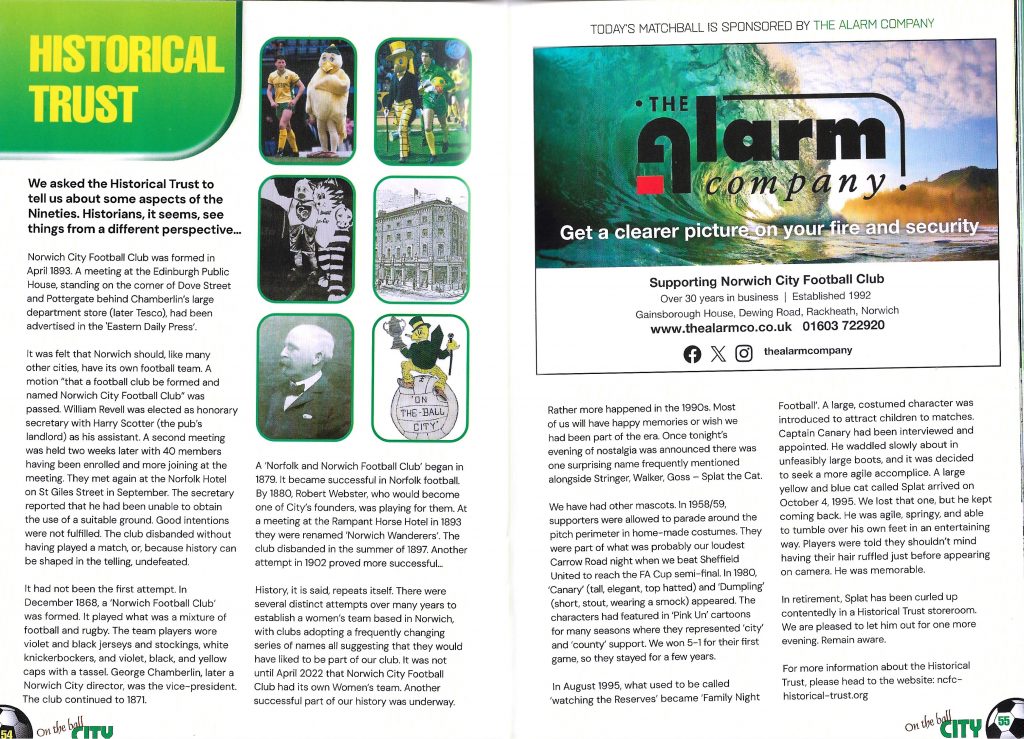
The full text of the article is also published here.
We asked the Historical Trust to tell us about some aspects of The Nineties. Historians, it seems, see things from a different perspective…
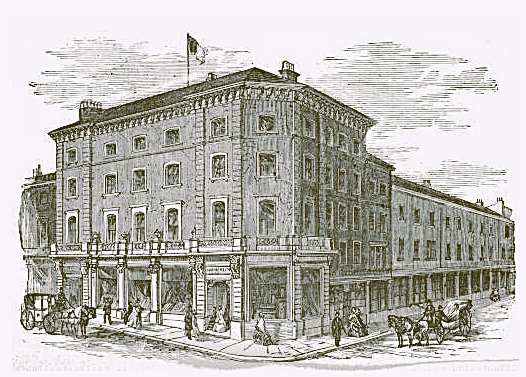
Norwich City Football Club was formed in April 1893. A meeting at the Edinburgh Public House, standing on the corner of Dove Street and Pottergate behind Chamberlin’s large department store (later Tesco), had been advertised in the ‘Eastern Daily Press’. It was felt that Norwich should, like many other cities, have its own football team. A motion “that a football club be formed and named Norwich City Football Club” was passed. William Revell was elected as honorary secretary with Harry Scotter (the pub’s landlord) as his assistant. A second meeting was held two weeks later with 40 members having been enrolled and more joining at the meeting. They met again at the Norfolk Hotel on St Giles Street in September. The secretary reported that he had been unable to obtain the use of a suitable ground. Good intentions were not fulfilled. The club disbanded without having played a match, or, because history can be shaped in the telling, undefeated.
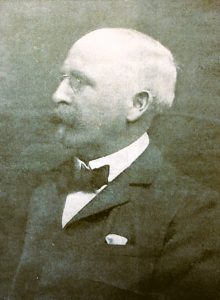
It had not been the first attempt. In December 1868 a ‘Norwich Football Club’ was formed. It played what was a mixture of football and rugby. The team players wore violet and black jerseys and stockings, white knickerbockers, and violet, black, and yellow caps with a tassel. George Chamberlin, later a Norwich City director, was the vice-president. (His image now adorns the development site opposite the Guildhall. The site had been the Chamberlin’s store and later Tesco as referred to above.) The club continued to 1871.
A ‘Norfolk and Norwich Football Club’ began in 1879. It became successful in Norfolk football. By 1880 Robert Webster, who would become one of City’s founders, was playing for them. At a meeting at the Rampant Horse Hotel in 1893 they were renamed ‘Norwich Wanderers’. The club disbanded in the summer of 1897. Another attempt in 1902 proved more successful…
History, it is said, repeats itself. There were several distinct attempts over many years to establish a women’s team based in Norwich, with clubs adopting a frequently changing series of names all suggesting that they would have liked to be part of our club. It was not until April 2022 that Norwich City Football Club had its own Women’s team. Another successful part of our history was underway.
Rather more happened in the 1990’s. Most of us will have happy memories or wish we had been part of the era. Once tonight’s evening of nostalgia was announced there was one surprising name frequently mentioned alongside Stringer, Walker, Goss Almighty – Splat the Cat.
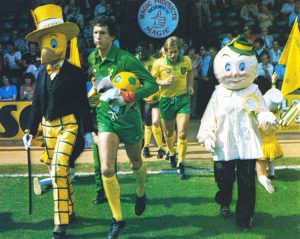
We have had other mascots. In 1958/9 supporters were allowed to parade around the pitch perimeter in home-made costumes. (They were part of what was probably our loudest Carrow Road night when we beat Sheffield United to reach the FA Cup semi-final.) By the 1970’s our team was welcomed to the pitch by a young lady in a Norwich kit 2 sizes too small. In 1980 ‘Canary’ (tall, elegant, top hatted) and ‘Dumpling’ (short, stout, wearing a smock) appeared. The characters had featured in ‘Pink Un’ cartoons for many seasons where they represented ‘city’ and ‘county’ support. (The same balance used to be reflected in the composition of our board.) We won 5-1 for their first game so they stayed for a few years.
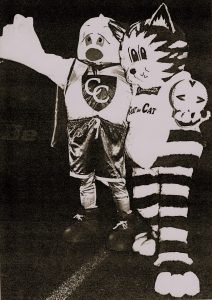
In August 1995 what used to be called ‘watching the Reserves’ became ‘Family Night Football’. A large, costumed character was introduced to attract children to matches. Captain Canary had been interviewed and appointed. He waddled slowly about in unfeasibly large boots, and it was decided to seek a more agile accomplice. A large yellow and blue cat called Splat arrived on 4 October 1995. (We lost that one 5-1 but he kept coming back.) He was agile, springy, and able to tumble over his own feet in an entertaining way. Players were told they shouldn’t mind having their hair ruffled just before appearing on camera. He was memorable.
(On 18 July 2013 we played Dorados de Sinaloa in a friendly match in Sacramento, USA. The temperature in the shade, of which there was little, was, appropriately to our theme, into the nineties. The host club’s mascot resigned.) In retirement Splat has been curled up contentedly in a Historical Trust storeroom. We are pleased to let him out for one more evening. Remain aware.