
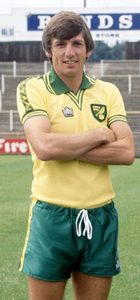
He was born in Plaistow on 8 November 1943.
At the time of his birth his family lived at Egham Road, Plaistow, Essex. His father worked for the Company of Watermen and Lightermen on the Thames; his mother worked as a waitress at a Lyons tearoom. Soon after he was born he was evacuated to the village of Roden in Shropshire.
While he was still young the family moved to Raydons Road, Dagenham. He attended Fanshawe Primary School and Fanshawe Secondary Modern School, Dagenham.
He played for London Schoolboys, and Essex Schoolboys. He also played 6 times for the England Under15 team in 1958/59.
West Ham United
He was taken onto West Ham United’s ground staff in May 1959 and was paid £6 a week in the football season; £5 in the summer. He’d signed as a professional for them on 12 November 1960. He played in their team that won the European Cup Winners’ Cup in 1965. He played in 364 League and Cup matches for them, scoring 100 goals.
He played 5 times, scoring 2 goals, for England Under23 from 7 November 1962 to 20 April 1966.
He married Kathleen Ward at St Martin’s Church in Dagenham on 8 November 1964, his 21st birthday. They would have a daughter and son and lived at Hornchurch.
World Cup Winner
He played 67 times for England, scoring 20 goals. He made his first England appearance in the 2-0 victory against Yugoslavia at Wembley Stadium on 4 May 1966, and his last in the 2-0 defeat by Scotland at Hampden Park on 18 May 1974.
He played for England in the team that won the Fédération Internationale de Football Association World Cup in 1966 and scored the second of their 4 goals against West Germany in the Final.
He, and other West Ham United players, played briefly for Baltimore Bays in the United States of America in the summer of 1969. On 16 March 1970 he was transferred from West Ham United to Tottenham Hotspur for a British record fee of £220,000 (along with Jimmy Greaves transferred to West Ham in part exchange).
He played for Tottenham Hotspur when they won the Union of European Football Associations Cup in 1972 and in their teams which won the Football League Cup in 1971 and (against City) in 1973. He played in 266 League and Cup matches for them, scoring 80 goals.
Signed from Tottenham Hotspur
He signed for Norwich City from Tottenham Hotspur on 13 March 1975 for a fee of £43,200. An initial payment of £23,200 was made, with an additional payment of £20,000 on 30 June 1975 [as shown by City’s ledgers; the reported fee was £40,000; Peters in his autobiography said £50,000.].
6’ 1⁄2”; 11st 10lb; A midfield player.
He became City’s captain and was awarded the Barry Butler Memorial Trophy for being voted City’s ‘player of the season’ for 1975/76 and 1976/77 by the club’s supporters. While with City he lived at Sprowston.
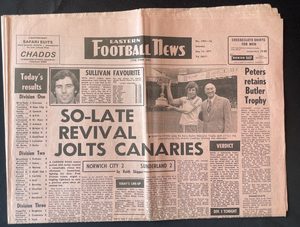
He was unsuccessful in his application to become player/manager at Orient and Jimmy Bloomfield was appointed to the position on 12 September 1977.
It was announced on 3 June 1978 that he was to be appointed as a Member of the Most Excellent Order of the British Empire for services to Association Football. He received the Order at Buckingham Palace on 21 November 1978.
City granted him a testimonial match at Carrow Road on 18 October 1978 in which most of the England team that won the Fédération Internationale de Football Association World Cup played. The attendance was 18,426.
During City’s tour to Australia he played for Frankston City on 26 May 1979. Later in that summer he played and coached in Australia for Melbourne.
Player/Coach at Sheffield United
On 31 July 1980 he was transferred from Norwich City to Sheffield United and was to become their player/coach. There was no transfer fee.
He played in 28 League and Cup matches for them, scoring 4 goals. He was appointed as their manager on 19 January 1981 and ended his League
playing career.
United were 12th in the table with 16 matches remaining but were relegated to Division Four and he resigned on 1 June 1981. Under
his management they won 3, drew 6, and lost 8 of 17 League and Cup matches.
Back to Norfolk
He and is family returned to Norfolk and lived at Salhouse.
In October 1981 he joined Gorleston, playing as a defender. He played for Reading in a friendly match against New Zealand. He also played for JJ Fun City, including in the 1984 Norfolk Thursday Cup Final in a match at Carrow Road. He worked for an insurance company until he was made redundant in July 2001.
He was a director at Tottenham Hotspur from 26 August 1998 to 31 August 2002.
In later life he developed Alzheimer’s disease. He lived at Shenfield in Essex.
He died on 21 December 2019. His ashes were interred within the foundations of the statue at London Stadium honouring him, Bobby Moore, and Geoff Hurst.